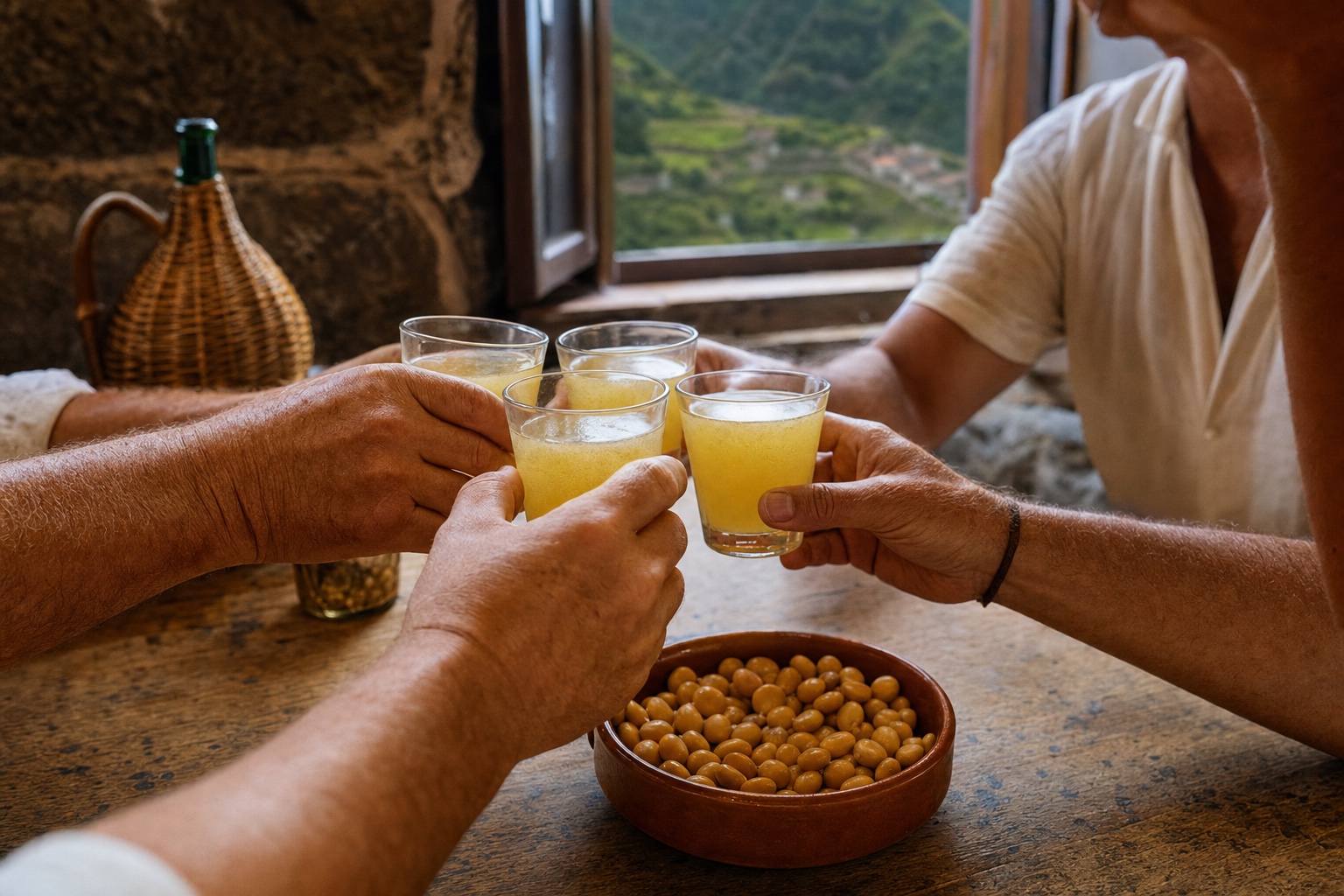
To understand poncha, you have to understand Madeira itself — an Atlantic island shaped by sugarcane, seafaring and the people who fished its waters. Poncha is not a modern cocktail invented for tourists. It is a drink with roots stretching back centuries, and today it enjoys genuine legal protection. This is its story.
If you are new to the drink, you may want to start with our overview of what poncha is before diving into the history.
It begins with sugarcane
Poncha's story starts with the plant that gives it its spirit. Sugarcane reached Madeira around 1425, soon after the island was settled, and it transformed the place. Madeira became one of Europe's earliest and most important sugar producers, and where there is sugarcane, distilling tends to follow.
From cane juice came aguardente de cana — a fiery agricultural spirit distilled directly from fresh sugarcane, rather than from molasses. This is the same family of spirit as Brazilian cachaça and French Caribbean rhum agricole, and it is the indispensable base of poncha. Without Madeira's sugarcane and its distilling tradition, there would be no poncha at all.
The fishermen of Câmara de Lobos
If sugarcane gave poncha its spirit, the fishermen of Câmara de Lobos gave it its soul.
Câmara de Lobos, a working fishing village just west of Funchal, is widely regarded as poncha's home. Out on the cold Atlantic, fishermen drank poncha to warm themselves and steel against the elements. Their version was strong and unsentimental — heavy on the aguardente, sharp with lemon, with little or no honey to soften it. This is the original recipe we now call Poncha de Pescador, "fisherman's poncha," and you can still try it today: see our Poncha de Pescador recipe.
Over time, as poncha moved from the boats to the tascas and vendas of the island, gentler versions appeared. Honey was added more generously, the citrus balanced more carefully, and the everyday Poncha Regional we know today took shape.
What's in a name? Punch, "five" and the spice route
The word "poncha" carries its own history. The most widely accepted theory traces it to the Indian word "pãnch" (or "panche"), meaning "five" — a reference to the five ingredients of an old drink (spirit, sugar, citrus, water and spice). This is the very same root that gives English the word "punch."
How that name reached Madeira is debated. One theory points to Portuguese sailors of the 16th century carrying it home along the spice routes from India; another credits an 18th-century English introduction, during the long centuries when British merchants were deeply established on the island. Both routes are plausible, and the truth may well be a blend of the two. Either way, poncha sits within a global family of "punch" drinks, while remaining entirely Madeiran in character.
Scurvy, sailors and the cure-all reputation
There is a practical thread running through poncha's history, too. Long sea voyages were haunted by scurvy, the disease caused by a lack of vitamin C, and citrus fruit was the known remedy. A drink combining citrus and spirit was both a pleasure and, in its way, a safeguard — easy to keep, easy to drink, and good for the crew's health.
That association lingers in Madeiran folklore today. Many islanders hold that poncha cures the common cold, thanks to the vitamin C of the citrus and the soothing honey. It is folk belief rather than medicine, of course — but it is a charming one, and you will hear it offered in all seriousness when someone has a sniffle. We address the question honestly in our FAQ.
Poncha's influence: the caipirinha connection
Poncha's reach may extend further than its small island. It is often said to have influenced the Brazilian caipirinha — and the resemblance is striking: a cane-based spirit, citrus, sweetness, hand-mixed and served fresh. Given Madeira's deep historical ties to Brazil and the shared sugarcane heritage, the family resemblance is no coincidence. Poncha can fairly claim to be one of the elders of the cane-and-citrus tradition.
Tascas, vendas and the culture of the drink
For most of its life, poncha was not a bar-menu cocktail but a community drink. It belonged to the tasca and the venda — small grocery-shop bars where neighbours met, gossiped and put the world to rights. Poncha was made fresh, one glass at a time, with a small snack on the side.
That snack, the dentinho, is part of the ritual: a complimentary bite — tremoços, peanuts, fava beans, fried polenta — handed over with the glass. It is hospitality made tangible, and it survives to this day. Our pairings guide explores the dentinho and the wider world of Madeiran food that goes with poncha.
Protected by law: authenticity and the fight against shortcuts
Here is where poncha's modern story becomes genuinely important — and it is the part every visitor should know.
As poncha's fame grew, so did the temptation to cut corners: to swap the costly, characterful aguardente for cheap vodka, or to use powdered, artificial mixes in place of real honey and fresh juice. To protect the drink and the producers who make it properly, Madeira put real legal safeguards in place.
- Rum da Madeira — the base spirit — holds Protected Geographical Indication (IGP/PGI) status, granted in 2011. This recognises it as a distinctive product tied to its place of origin.
- "Poncha da Madeira" was confirmed as a protected and regulated designation by a Regional Legislative Decree in 2014. Under this protection, authentic poncha must be made with Rum/Aguardente da Madeira — not vodka, and not powdered mixes.
- In 2017, the regional institute IVBAM (which oversees Madeira's wine, embroidery and handicrafts) introduced the "Poncha AQUI é com Rum da Madeira" certification logo. Establishments displaying it are pledging to make genuine poncha with real Madeiran aguardente.
This is the heart of poncha's authenticity. Real aguardente versus the vodka-and-powder shortcut is the dividing line between a true Madeiran poncha and a hollow imitation. When you look for the certification logo, or simply ask whether the poncha is made with Rum da Madeira, you are taking part in keeping the tradition honest. Our guide to poncha bars explains how to find the real thing.
From the boats to the world
From a sugarcane plant in 1425 to a fisherman's warming cup, from a punch-route loanword to a legally protected designation — poncha has travelled a long way while changing remarkably little. Its appeal is exactly the same as it ever was: a few honest ingredients, mixed by hand and shared.
Ready to taste that history? Learn what poncha is in full, browse our recipes to make it at home, or find the genuine article in our guide to the best poncha bars.