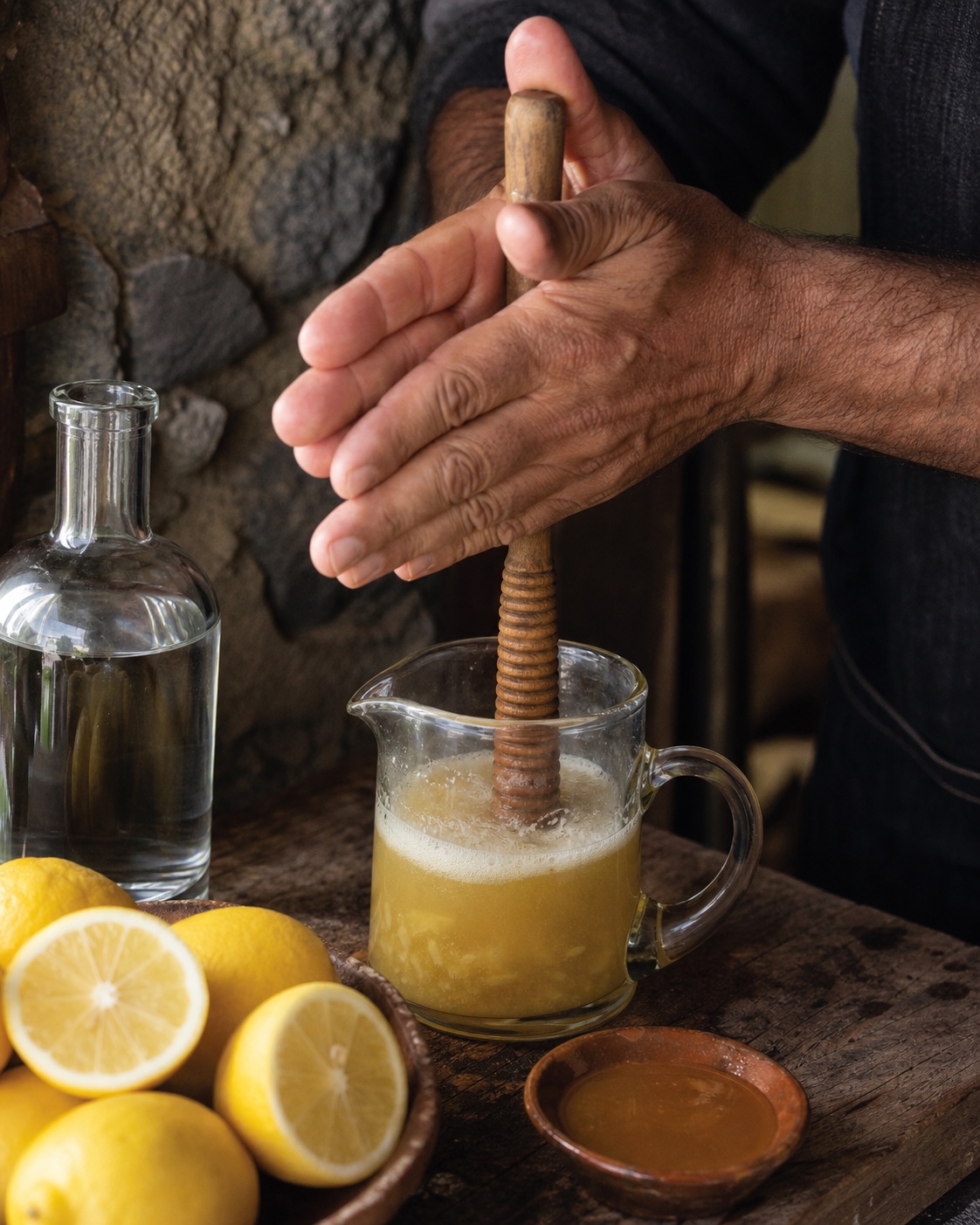
There are few things more Madeiran than a glass of poncha. Order one in a small tasca in the hills above Funchal and you will watch it made in front of you — honey and lemon worked together by hand, sugarcane spirit poured in, and a grooved wooden stick spun between the palms until the whole thing turns pale, soft and frothy. It is simple, generous and unmistakably of this island.
This page is the complete introduction: what poncha is, what goes into it, how it is made, how strong it really is, the varieties you will meet, and where to drink it. If you only read one page about Madeira's drink, make it this one.
Poncha in one sentence
Poncha is Madeira's traditional drink — an emulsion of aguardente de cana (Madeiran sugarcane spirit), honey and fresh citrus juice, mixed by hand with a wooden tool called a mexelote until light and frothy, and served fresh in a small glass.
It is widely regarded as the island's unofficial national drink. You will find it everywhere from rustic grocery-shop bars in the mountains to polished cocktail lists in town, but at heart it remains a humble, handmade thing.
What poncha is made of
The classic recipe is famously short. Three ingredients do all the work:
- Aguardente de cana — a Madeiran sugarcane spirit of around 50% ABV. This is an agricultural rum, officially Rum da Madeira, distilled from fresh cane juice rather than molasses. It is the soul of the drink, and authentic poncha is always made with it. (More on this in our history of poncha and its protected status.)
- Honey — traditionally bee honey, mel de abelha, though some houses use sugar-cane honey. The honey sweetens, rounds out the spirit and helps create the signature froth.
- Fresh citrus juice — usually lemon, sometimes orange, freshly squeezed. The acidity is what makes poncha so drinkable; it cuts the sweetness and lifts the whole glass.
That is the foundation. From there, individual fruits open up a family of variations — passion fruit, tangerine, orange — which we cover in our recipes.
Authentic poncha is made with real Madeiran aguardente — never vodka, and never a powdered mix. That distinction matters, and Madeira protects it in law.
How poncha is made: the mexelote and the caralhinho
The method is as important as the ingredients, and it is what separates a true poncha from a mere citrus cocktail.
Poncha is mixed, never shaken. The tool is a grooved wooden muddler-cum-swizzle-stick. Its proper name is the mexelote; islanders affectionately call it the caralhinho, a cheeky colloquial nickname you will hear in every bar.
Here is the sequence:
- Honey and fresh lemon juice go into a glass or small jug.
- The mexelote is worked up and down to dissolve the honey completely into the juice.
- The aguardente is added.
- The stick is held upright and spun rapidly between the palms, the way you might roll a stick to start a fire. This aerates the mix and emulsifies it into a soft, pale froth.
- It is poured into a small glass and served straightaway — traditionally without ice.
No blender, no cocktail shaker, no ice-filled tin. The hand-spun method is the tradition, and it produces a texture you simply cannot get any other way. Want to try it yourself? Start with our flagship Poncha Regional recipe.
How strong is poncha?
Deceptively strong. This is the single most important thing for a visitor to know.
The base aguardente is around 50% ABV. Once mixed, a freshly served glass of poncha generally falls somewhere between 20% and 30% ABV, depending on how much honey and juice the house adds and how generous the pour is. That is comfortably stronger than wine, and roughly in the territory of a stiff cocktail.
The catch is that poncha does not taste strong. The honey and citrus mask the alcohol so well that it slips down like lemonade. Many a visitor has ordered a second, then a third, and discovered the hard way why locals sip rather than gulp.
Bottled commercial poncha — the kind sold to tourists in souvenir shops — is often weaker, around 25% ABV or less, and rarely matches a fresh one made in front of you. We compare the two in our FAQ.
The rule: treat poncha with respect. Sip it slowly, enjoy the ritual, and have some food alongside.
The main types of poncha
Naming varies from house to house across the island, so do not be surprised if your version differs slightly from the next village's. These are the main types you will encounter:
Poncha Regional
The everyday classic and the one most people mean when they simply say "a poncha": aguardente, honey and lemon, balanced and smooth. It is the master recipe, the benchmark, the place to start. See the full Poncha Regional recipe.
Poncha de Pescador
"Fisherman's poncha" — the original and most bracing version, historically drunk by the fishermen of Câmara de Lobos to warm themselves at sea. More aguardente, sharp lemon, and little or no honey, sometimes finished with sugar and a strip of lemon zest. Not for the faint-hearted. Try our Poncha de Pescador recipe.
Fruit variants
A family of sweeter, more aromatic versions built on the same base:
- Poncha de Maracujá — passion fruit; fragrant and tropical.
- Poncha de Tangerina — tangerine; bright and sweet-tangy, a seasonal winter gem.
- Poncha de Laranja — orange; smooth and gentle, the easiest introduction for newcomers.
Browse all of them in our recipes collection.
Where poncha comes from
Poncha is bound up with the history of sugarcane on Madeira and, above all, with the fishermen of Câmara de Lobos, who drank it to keep warm out on the water. Its name probably traces back to the same root as the English word "punch" — and there is even a theory that poncha helped inspire the Brazilian caipirinha.
We tell the full story, including its protected legal status and the certification that marks genuine poncha, on our dedicated history page.
How poncha is drunk: tascas, vendas and the dentinho
Poncha belongs to a particular kind of place: the tasca and the venda, small grocery-shop bars where locals gather. It is sociable, unpretentious drinking.
It almost always comes with a dentinho — a small complimentary snack to accompany the glass. Tremoços (lupini beans), peanuts, fried polenta cubes, fava bean salad or boiled shrimp are all classics. Beyond the dentinho, poncha pairs beautifully with Madeiran food: bolo do caco, grilled limpets (lapas), fresh fish and espetada. We cover all of this in our guide to poncha pairings.
Where to drink poncha in Madeira
You can find good poncha all over the island, but a few areas are especially associated with it: Câmara de Lobos (its birthplace), Funchal's Old Town and the Mercado dos Lavradores, plus mountain villages like Serra de Água, Camacha and São Vicente.
For pointers on finding the real thing — and how to spot a place making poncha with genuine aguardente — see our guide to the best poncha bars.
In short
Poncha is Madeira distilled into a glass: sugarcane spirit, honey and citrus, made by hand, shared with friends and a little snack on the side. Simple to describe, surprisingly easy to love, and best enjoyed slowly. Now that you know what it is, why not make one yourself — or read on for its remarkable history.